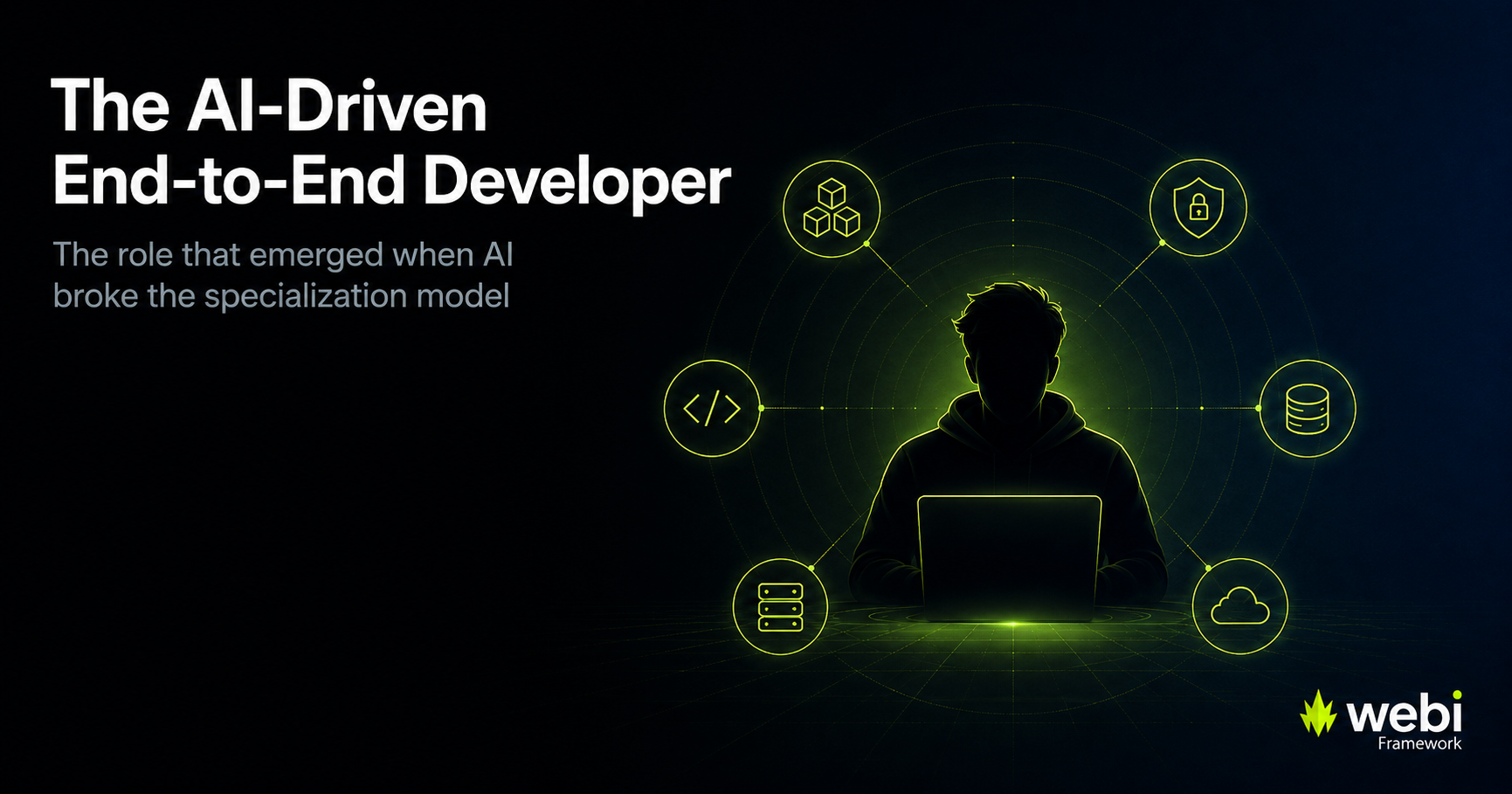
The role that emerged when AI broke the specialization model.
When we began applying AI as the production engine in real software projects, the first thing we noticed was not a tool problem. It was a knowledge problem.
My own interaction with AI was shaped by over 20 years of working at the systems level — designing architectures, specifying how things should be built, maintaining control over the quality of what was produced. I was not just focused on whether the code worked. I was focused on whether it was built correctly: the right patterns, the right boundaries, the right trade-offs. That approach, which was more instinct than method at the time, produced results. We started solving highly complex problems with AI that would have been impractical to tackle before due to cost and time constraints.
Then we tried to replicate it.
The wall we did not see
When other developers on the team used the same tools, the same AI, the same methodology, the results were fundamentally different. Code had to be rewritten. Quality issues appeared that the developers could not detect on their own. There were too many factors outside of control. It looked, at first, like AI was simply unreliable — like you could not predict what it would produce.
That conclusion was wrong. What we were observing was not an AI problem. It was a knowledge problem made visible by the speed at which AI operates.
What seniority actually means
When we put senior developers into the same flow, results improved dramatically. That confirmed the hypothesis: the differentiating variable was knowledge. But here is the part that matters most — it was not exotic knowledge. It was not something only accessible after decades of work. It was the same foundational knowledge that any software engineering program is supposed to teach: design patterns, architectural reasoning, security principles, data modeling, infrastructure fundamentals.
The difference between a senior who succeeded and a junior who did not was not that the senior knew different things. It was that the senior could apply those things. They understood where each concept fits in the larger puzzle of system design. They had internalized the foundations to the point where they could make decisions with confidence and evaluate whether AI output was correct or not.
This is what seniority actually is. Not years of experience as a measure of time served. Autonomy — the condition in which foundational knowledge is deep enough to make decisions with judgment and sufficient certainty, without requiring constant supervision. The quality of those decisions depends directly on how well the person understands architecture, security, data, infrastructure, and system design.
Why the industry struggles to produce this profile
The problem is that historically we have not been especially good at developing this level of mastery from the early stages of a career. In most cases it comes after years of exposure to real problems, real decisions, and real consequences. The industry has relied on hard experience as the path to seniority — and that path works, but it is slow and inconsistent.
Everyone who studied software engineering was exposed to the same body of knowledge. Design patterns, data structures, architectural principles. The curriculum exists. What does not consistently exist is the ability to apply it. The gap between knowing that something exists and knowing when and how to use it in context is where most professionals stall. And AI makes that gap impossible to hide, because the developer directing AI must evaluate what it produces in real time, across domains they may have studied but never practiced.
The AI-Driven End-to-End Developer
From this research, a profile emerged that the market has not formalized. We call it the AI-Driven End-to-End Developer: a developer who possesses the professional fundamentals necessary to implement solutions using AI that span end-to-end across all domains required to deliver a functional product.
This means infrastructure, backend, frontend, data, and security — not as isolated competencies but as a continuous flow. One person directing AI from the deployment layer through business logic to user interface, delivering complete functional scope in each iteration.
This is not the "fullstack developer" as the market has defined it. The fullstack label historically assumed you memorize every framework and technology across front and back. The AI-Driven End-to-End Developer does not need to memorize anything. What they need is the foundational depth to direct AI across any domain and evaluate whether what it produces is correct. The foundations are the constant. The specific technologies are the variable — bounded by whatever stack the organization has defined.
Why end-to-end
In practice, the highest productivity with AI comes when you implement complete functional flows through the entire system — not isolated features, not frontend then backend, not small tasks one after another as in traditional Scrum. The real results, the measured 10x and above, come from taking a portion of the system and implementing it transversally across all layers, from beginning to end, to complete a functional scope.
This is what end-to-end means in this context. Not just "touches all layers" but "delivers a complete, verifiable capability in one continuous flow." When a developer operates this way with AI, there is no coordination overhead between specialists, no handoff friction, no waiting for another piece to be ready. The flow is continuous from the moment it starts until the scope is complete.
But this only works when the person directing it understands what is happening across all those layers. If they understand infrastructure, backend, frontend, data, and security at the level required to evaluate AI output, they can operate end-to-end with confidence. If they only understand one slice, the rest ships unverified.
The knowledge challenge
The practical challenge for making this role viable is exactly that foundational layer. If someone can conceptually apply design patterns, understand when a specific pattern solves a specific problem, evaluate architectural decisions, and reason about system behavior — at least at a theoretical level that enables them to direct AI effectively — then we have the base for this new profile.
That is, in a sense, the new junior. Not someone who writes code manually at a beginner level. Someone who has sufficient cognitive depth to take AI and start producing real solutions — building toward seniority through practice on top of a solid conceptual foundation, rather than hoping that years of exposure will eventually produce the depth that was never deliberately developed.
The gap between where most professionals are today and what this role requires is real. Most engineers do not arrive prepared this way. The industry trained them toward narrow specialization, and formal education — while it covers the fundamentals theoretically — rarely develops the applied understanding that AI-First operation demands.
What we are working on
Closing that gap is what we are actively working on within Webi Framework. We want to contribute to the evolution of how technical knowledge is treated in this profession. Instead of measuring developers by programming skills (languages known, frameworks memorized), we are working toward a model where readiness is measured by cognitive skills: systems design, applied design patterns, structural reasoning, high-concurrency systems, security architecture.
The AI-Driven End-to-End Developer is not a distant aspiration. It is the profile that already produces results when the foundation exists. The work ahead is making that foundation deliberately achievable — not after a decade of trial and error, but as a structured path that the profession can adopt.